
Porsche Benzine-Electric Locomotives and the Defence Train in World War One

Porsche Benzine-Electric Locomotives and the Defence Train in World War One
Mike Christensen OBE
144 pages. 275x215mm. Printed on gloss art paper with colour laminated board covers.
ISBN13 : 9781915069719
£30.00
Mike Christensen OBE
144 pages. 275x215mm. Printed on gloss art paper with colour laminated board covers.
ISBN13 : 9781915069719
£30.00
In the first decade of the 20th Century, Ferdinand Porsche designed a hybrid benzine (petrol)-electric drive for motor cars. In conjunction with an officer in the Austria-Hungary army, the concept was developed to produce a system in which a benzine-electric tractor hauled a ‘road train’ of carts which were also powered by electric motors. The Austria-Hungary army adopted the design to create a railway locomotive, with associated motorised wagons, which could operate on lightly laid track, tight radius curves and gradients as steep as 1 in 12 – the Landwehr Zug (Defence Train). This equipment was used in very challenging environments during the 1914-1918 war on two military railways in Eastern Europe – No. 1 from Dorny Völga to Borgó Tiha and No. 2 from Dutovlje-Skopo to Kostanjevica and Lipa. This book tells the story of the development of the benzine-electric system, the Landwehr Zug and the operation of those two military railways. It uses many photographs taken by the Army’s official photographer, including some from the archives of Porsche AG. It also looks at the battles involving the armies of Austria-Hungary, Russia, Germany and Italy that required strategic and tactical military railways of a rare kind.
Porsche Benzine-Electric Locomotives and the Defence Train in World War One - Sample Images
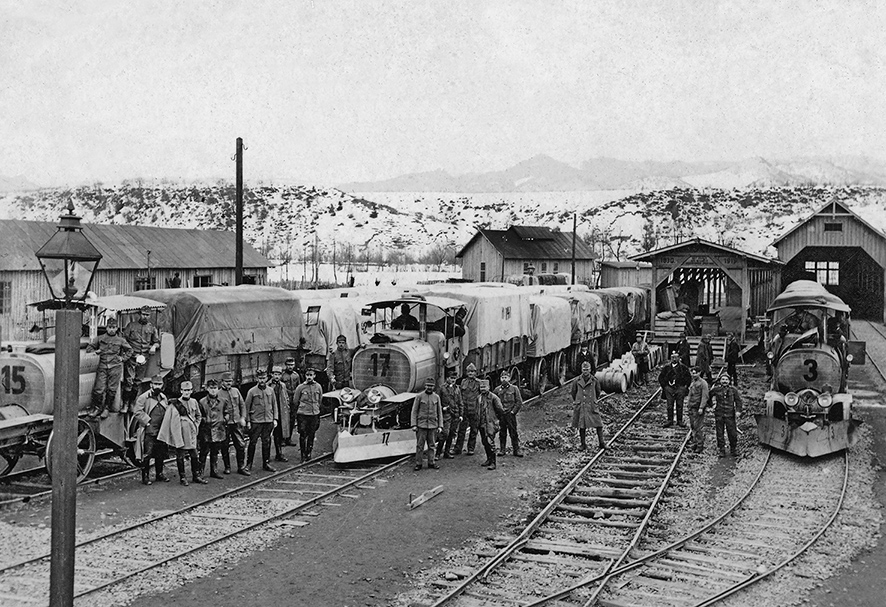
A clearly posed view of the railway yard at Borgó Tiha, looking in the direction of Borgó Prund. The snow ploughs were dedicated to individual locomotives and numbered as such. The lightweight nature of the track in the yard and in particular the common crossing (‘frog’) in the points, is evident.
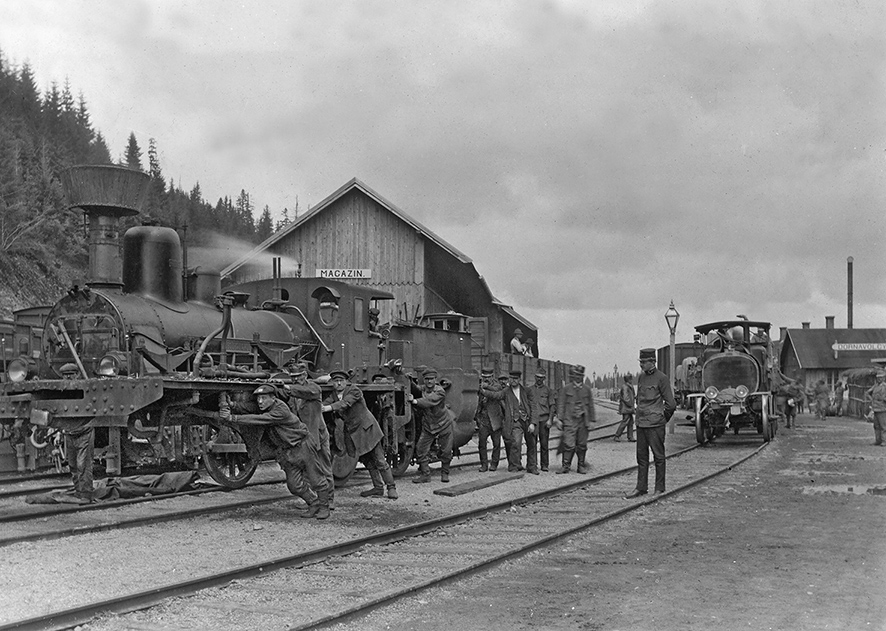
Something of a confusing photograph at first glance but one which shows that so much of the work was pure manual hard graft. This set of frames are probably from an 0-6-0 tender locomotive similar to the one on the track behind (but with one pair of wheels already removed) and the gang of men – including one standing in between the rear of the frames – are moving them by hand in the station yard at Dorna Völgy. On the right, benzine-electric locomotive No. 25 had its train made up ready to depart, its design meaning that it was of no use in trying to move the frames. The signage on the large building on the left indicated its use as an ammunition store.