
Engine Driving Lives

Engine Driving Lives
John Leach
416 pages. 275x215mm. Printed on gloss art paper with colour laminated board covers.
ISBN13 : 9781915069702
£45.00
John Leach
416 pages. 275x215mm. Printed on gloss art paper with colour laminated board covers.
ISBN13 : 9781915069702
£45.00
During the centenary celebrations of the Flying Scotsman locomotive in 2023, much was spoken about its fascinating history but almost nothing was said about the drivers and firemen, whose Herculean efforts enabled its amazing achievements. It was in this moment that the author, a driver himself, realised that there was significant gap in the history of locomotives and the working of trains. In 416 pages and around 400 illustrations, plus tables and ephemera, this book recounts the history of footplatemen in considerable detail. From William Richards, who drove the first train on the Penydarren Tramroad at 5mph in 1804, through to the men and women who are daily at the controls of trains running from St. Pancras to Brussels and Paris at up to 186mph, this is a very thorough account of a profession which has never been explained in full before. Many people have a stereotypical image of an engine driver but this book offers deeper insights into the joys and sorrows, the disciplines and dangers, and the complex shift patterns which so impact family lives. The author has researched over 1,400 named individuals and has explored, in seventy human vignettes, something of their achievements, career moves and glimpses of their lives away from the railway. This work not only fills a huge gap in our railway history but reveals fresh insights into the daily challenges of driving locomotives and running trains over the past 200 years. Contents Introduction - Chapter 1:The Driver - Chapter 2:Pioneers - Chapter 3:The Working Environment - Chapter 4: Faster and Heavier - Chapter 5:Conditions of Service - Chapter 6 :All in a Day’s Work - Chapter 7:Measured Performance – 1 - Chapter 8:Accidents - Chapter 9:Wartime Service - Chapter 10:ASLEF - Chapter 11:The Big Four – Plus One - Chapter 12:Measured Performance – 2 - Chapter 13:Through the Links - Chapter 14:British Railways: A New World - Chapter 15:New Forms of Traction - Chapter 16:Steam: The Final Years - Chapter 17:Rationalisation and Redundancy - Chapter 18:Conditions of Employment - Chapter 19:British Rail: A Changing World - Chapter 20:An Oral Culture - Chapter 21:Commemorated Men - Chapter 22:Beyond the Railway - Chapter 23:Privatisation - Chapter 24:The Heritage World – Epilogue - Appendix I:Glossary of terms - Appendix II:Stockton & Darlington Railway Drivers, 1825-1840 - Appendix III:Liverpool & Manchester Railway Drivers, 1829-1840 - Appendix IV:Extract: GWR Register of Drivers and Firemen, 1841-47 - Appendix V:Drivers & Firemen Named in the Letters of ‘Veritas Vincit’, 1842-1847 - Appendix VI:Some Locomotives and Their Crews in the ‘Race to the North’, 1895 - Appendix VII:Secretaries Attending The MIC Conference at Derby, 1921 - Appendix VIII:Letter from R.L. Wedgwood to Fireman A. Wightman, 5th March 1935 - Appendix IX:Spotlight on my Job: No. 3 – Driver David Parsons (Old Oak Common) - Appendix X:Motormen at Brighton, 1933 - Appendix XI:Eastern Region Footplate Staff Establishment, 26th December 1964 - Appendix XII:Non-Technical Skills - Appendix XIII:An L&NWR Driver’s Log Book 1900-1905 - Bibliography - INDEX OF DRIVERS, FIREMEN & SECONDMEN
Engine Driving Lives - Sample Images
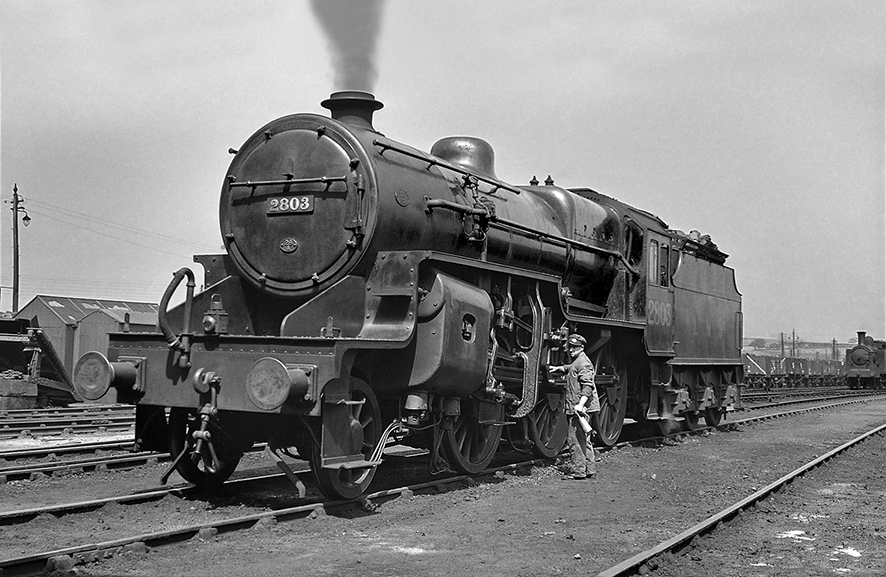
Preparing the locomotive. Essential to a good days work and punctual running is a ‘good preparation’, where the driver checks and tests various items of equipment, whilst the fireman attends to the boiler and other duties. A major part of the driver’s work is to lubricate the many bearings and sliding surfaces; particularly difficult on locomotives with inside cylinders and motion. In this view of LM&SR 2-6-0 No. 2803 at Motherwell shed, the driver is oiling the outside motion and an oil feeder bottle can be seen in his left hand. On a locomotive of this size, one hour was allowed to undertake the preparation. If it is done well, the crew can leave the shed in the knowledge that the locomotive is in good order and if a failure does occur it will not be their fault. The locomotive had been new into traffic as LM&SR No. 13103 on 19th December 1928 but had been renumbered as No. 2803 on 7th June 1935. This was also the year in which the LM&SR introduced shed codes and small oval cast iron plates carrying them, mounted on the smokebox door – 28A here for Motherwell – so this view is probably circa 1937-38. Les & David Hanson/Rail Archive Stephenson
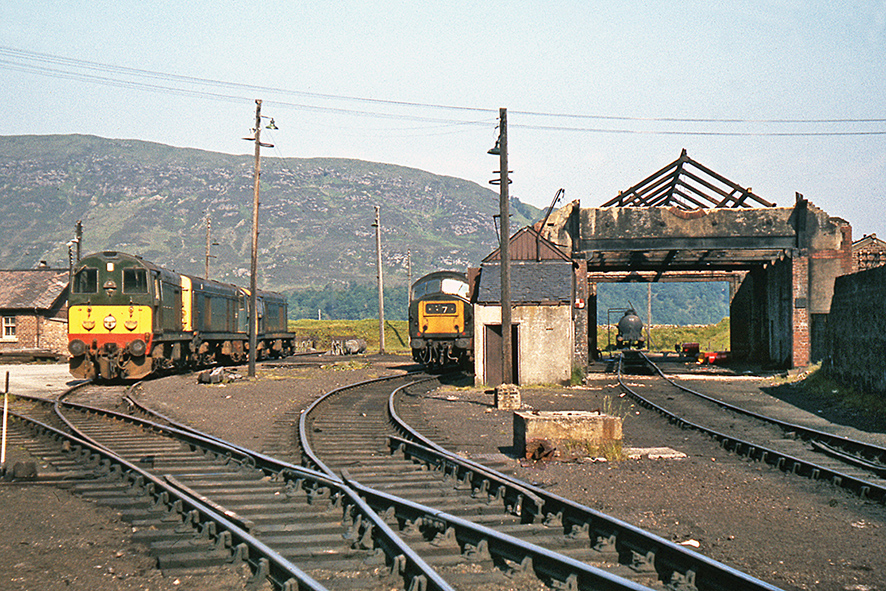
Built in 1894 by the North British Railway, Fort William shed served the line until its closure to steam in June 1962. It had various codes – FW, 63D, 65J, 63B and 65H – and had one sub-shed at Mallaig. This June 1968 view shows the shed still in use for servicing, with three EE Type ‘1’ (later Class ‘20’) diesels on the left and NBL Type ‘2’ (Class ‘21’), right. The building had been rationalised with the removal of one running road and also the roof, the latter a quite common occurrence towards the end of steam working, as it then ceased to be classed as a building and was not therefore liable for the payment of rates. In 1975, a new diesel depot was opened near Inverlochy called (in Gaelic) Tom-na-Faire. At a later date, this new depot was also used to service steam locomotives for the workings to Mallaig. The original Fort William turntable was removed to the Severn Valley Railway but with the return to steam operation, the turntable from London Marylebone has been relocated here. Joe Richardson/Colour-Rail